

- By Aziza Abbassi
- 18/07/2026
- DÉVELOPPEMENT DURABLE
The Challenge: Feeding Africa Without Fueling Emissions.
Africa's agrifood systems emit approximately 2.9 billion tonnes of CO₂ equivalent annually representing about 1/4 of global agrifood system emissions according to FAO data. Between 2000 and 2021, this footprint grew by roughly 40%, rising from 2.03 to 2.85 Gt CO₂e. At the same time, more than 307 million Africans face undernourishment, and the continent's population is projected to reach 2.5 billion by 2050. The continent finds itself at a critical crossroads: produce more food to feed a growing population, but without increasing and ideally while reducing agricultural emissions. This is where low-carbon, water-smart agriculture becomes not just an environmental imperative but an economic and strategic one.
The Nexus Imperative: Water, Energy, Food, and Ecosystems.
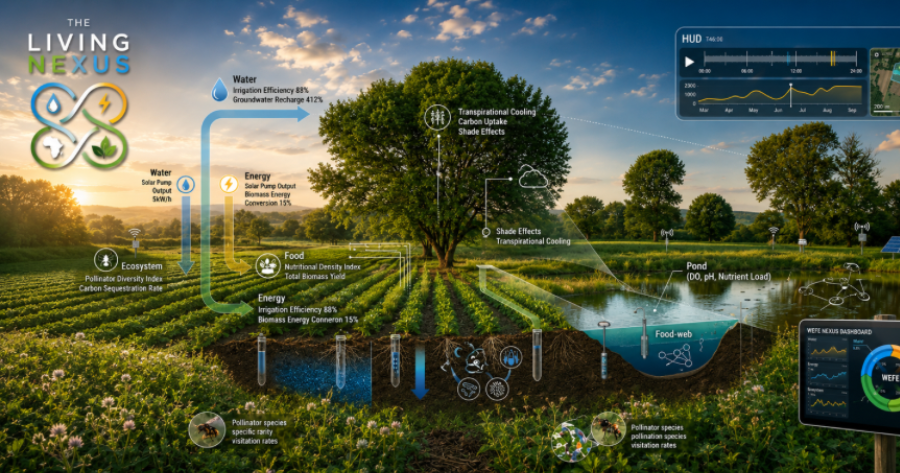
Water, energy, agriculture, and climate are not separate issues. They form a single, interconnected system. This is the essence of the Water-Energy-Food-Ecosystems (WEFE) Nexus approach a framework increasingly adopted across Africa and the Mediterranean to address the complexity of agricultural challenges. Morocco, for instance, has been called upon to review silo methodological approaches by adopting Nexus concepts of interconnectivity. Research projects like PRIMA SureNexus are demonstrating the effectiveness of circular economy practices and nature-based solutions for implementing the Nexus in the citrus sector. Similarly, the PRIMA NEXUSLAB project is testing innovative solutions across nine Living Labs in the Mediterranean basin, generating tangible evidence and laying the groundwork for scalability. Why does this matter for low-carbon agriculture? Because sustainable intensification of agroecosystems involves exploring the connectivity among water, soil, waste, climate, and food production. When these connections are understood and leveraged, resource efficiency improves, emissions fall, and resilience to water stress increases.
Solar-Powered Irrigation: A Zero-Emissions Leapfrog.
One of the most promising low-carbon solutions for water-stressed agriculture is solar-powered irrigation. In sub-Saharan Africa, this zero-emissions technology has the opportunity to leapfrog traditional manual and diesel-powered systems. A recent analysis by the International Food Policy Research Institute (IFPRI) provides compelling evidence of both the economic feasibility and emissions reduction potential of solar irrigation.
Emissions Reduction Potential Across Countries (based on IFPRI analysis): (Country Annual Reduction per Hectare Total Annual Reduction for Irrigated Maize):
- Nigeria ~500 kg CO₂/ha Up to 4,000,000 metric tons CO₂
- Ethiopia ~300 kg CO₂/ha Up to 600,000 metric tons CO₂
- Kenya ~200 kg CO₂/ha Up to 500,000 metric tons CO₂
(Source: IFPRI analysis (December 2025).
The technology offers multiple advantages:
- Climate-friendly: Zero direct emissions compared to diesel pumps
- Cost-effective: Rapidly declining solar panel costs make it increasingly affordable
- Resilience-building: Supports productivity even during dry spells and droughts
- Income-enhancing: Evidence suggests irrigation can double agricultural incomes
Promoting solar irrigation requires supportive regulatory frameworks, financial instruments that reduce upfront costs for farmers, and access to climate finance or carbon market schemes.
Agrivoltaics: Harvesting the Sun Twice.
A particularly innovative approach gaining traction is agrivoltaics the integration of agriculture with photovoltaic panels on the same land. Recent research from East Africa demonstrates that these systems address food, energy, and water insecurity simultaneously.
Key findings from studies in Tanzania and Kenya:
- Low-carbon electricity generation while maintaining agricultural production
- Reduced irrigation demand through panel shading some crops achieved greater yields with less water input
- Rainwater harvesting from panel runoff further reduces irrigation need
- Improved crop survivability during warm periods, indicating climate change resilience
- Enhanced land productivity across all crops at both study sites
Agrivoltaics, whether grid-tied or off-grid, could address multiple Sustainable Development Goals in East Africa simultaneously by contributing to energy security, climate-resilient food production, and water conservation.
This article is part of The Living Nexus initiative by We Act Media, exploring the intersections between water, energy, food systems, and ecosystems across Africa.
Sources
- FAO. (2023). The share of agrifood systems in total greenhouse gas emissions. Global, regional and country trends 2000–2021. Rome.
- IFPRI. (2025). Solar-Powered Irrigation in Sub-Saharan Africa. International Food Policy Research Institute.
- PRIMA Foundation. (2023). PRIMA - Partnership for Research and Innovation in the Mediterranean Area. Horizon 2020.
- IPCC. (2022). Climate Change 2022: Mitigation of Climate Change. Working Group III.
- Renewable and Sustainable Energy Reviews. (2025). Agrivoltaic systems in East Africa.
- Applied Energy. (2026). Economic viability of agrivoltaics in Tanzania.
Publié par We Act Media. Stories, insights & solutions for sustainable impact.